Skip navigation
gesund.bund.de - Reliable information for your health gesund.bund.de - Reliable information for your health
  • Deutsch
  • English
  • Türkçe
  • Русский
  • عربي
Sprache Language Dilim Язык اللغة
Search
  • Display format Display format
  • Sign language Sign language
  • Simple language Simple language
  • Bookmark list Bookmark list (0)
 
Skip navigation
  • Healthcare

    • Healthcare

    • The healthcare system
    • Health literacy
    • Help and advice
    • Patient rights
    • Self-help
    • Services and benefits

    • Health insurance
    • Benefits for those with health insurance
    • Prescription drugs
    • Prevention and screening
    • Out-of-hospital intensive care
  • Care

    • Topics

    • Long-term care insurance
    • Care benefits
    • Family carers
    • Everyday care and home life
  • Digital health

    • Digitization in healthcare

    • Health and digitization
    • Telemedicine
    • Digital applications

    • Electronic health record (ePA)
    • Electronic medical data cards (eGK)
    • Health apps (DiGA and DiPA)
    • E-prescriptions
    • Electronic sick leave notice
  • Healthy living

    • Staying healthy

    • Prevention and screening
    • Diet and exercise
    • Psyche and well-being
    • Saving lives and helping people
    • Managing addiction
    • Environment and health
    • Life stages

    • Growing up healthily
    • Workplace health
    • Pregnancy and birth
    • Health in old age
  • Conditions

    • Topics

    • Respiratory system
    • Eyes
    • Circulatory and lymphatic systems
    • Reproductive organs
    • Ear, nose and throat
    • Skin
    • Cardiovascular system
    • Hormones
    • Immune system
    • Head and nervous system
    • Psyche
    • Muscles, bones and joints
    • Kidneys and urinary tract
    • Digestion and metabolism
    • Teeth and gums
    • Special topics

    • Allergies
    • coronavirus
    • Infections and infectious diseases
    • Cancer
    • Conditions A–Z
  • Services

    • Information

    • Emergency numbers
    • ICD and OPS codes
    • Conditions A–Z
    • Glossary
    • Infection radar
    • Media library
    • Search functions

    • Doctor search
    • Hospital search
    • Pharmacy search
 
  • Display format Display format
  • Sign language Sign language
  • Simple language Simple language
  • Bookmark list Bookmark list (0)

Conditions Senile purpura

Read out loud

These functions require cookies. Go to Settings

  • Content

  • At a glance
  • Definition
  • Symptoms
  • Causes
  • Risk factors
  • Prevalence
  • Outlook
  • Prevention
  • Diagnosis
  • Treatment
  • Sources

ICD codes: D69.2 What are ICD codes?

Senile purpura refers to skin hemorrhages that occur in the elderly without any major external impact. It is caused by age-related changes to the skin which are mainly due to UV radiation.

At a glance

  • Senile purpura describes bruising that occurs in the elderly without any major external impact.
  • Senile purpura is not dangerous.
  • The bruises clear up on their own after 1 to 3 weeks.
  • It mainly affects areas of the skin that have often been exposed, unprotected, to the sun during the person’s life. 

Note: The information in this article cannot and should not replace a medical consultation and must not be used for self-diagnosis or treatment.
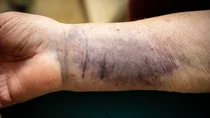
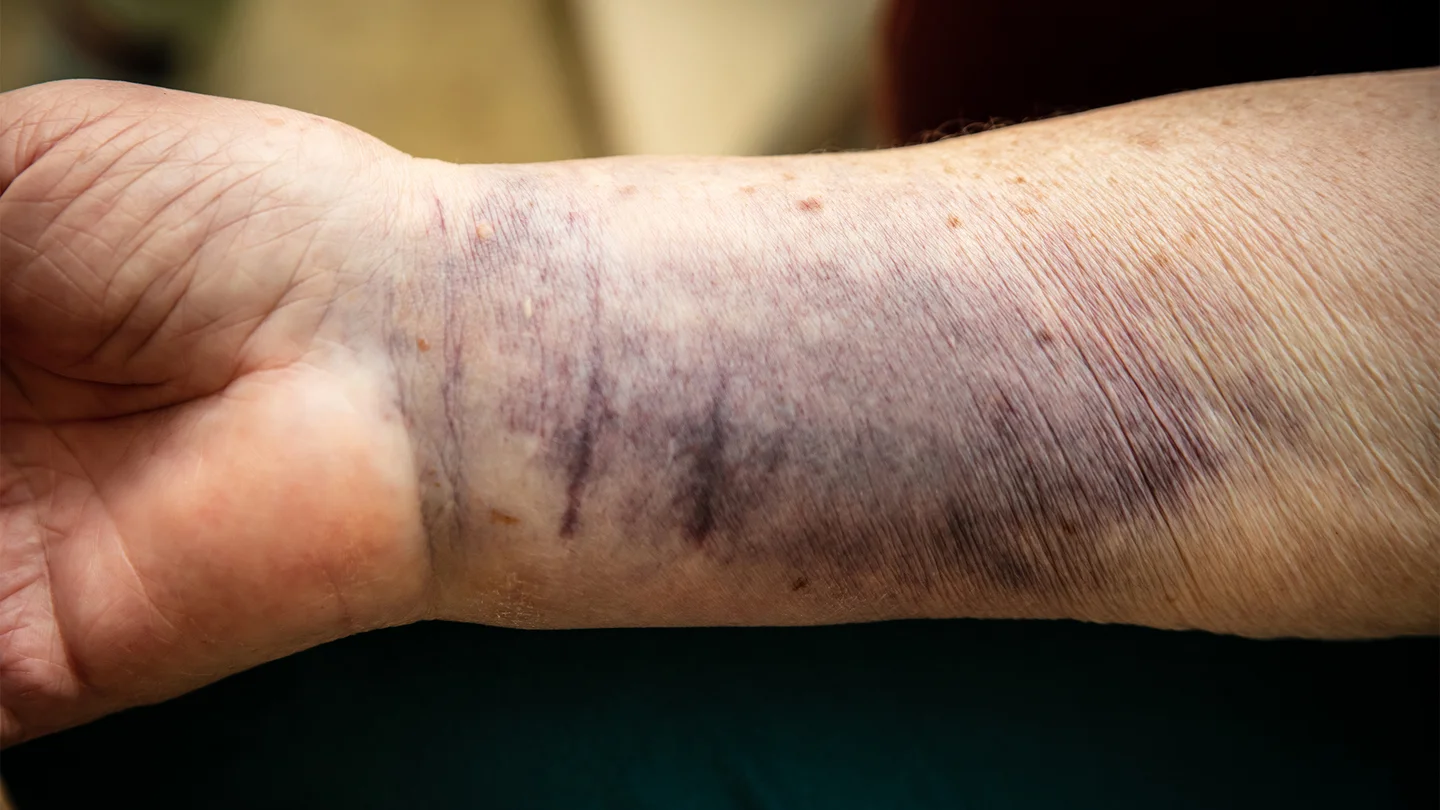
Senile Purpura: Das Handgelenk einer älteren Person weist einen großflächigen blau-violetten Flecken auf. Senile Purpura: Das Handgelenk einer älteren Person weist einen großflächigen blau-violetten Flecken auf.

What is senile purpura?

Bruising that occurs in the elderly is known as senile purpura or purpura senilis.

The bruising beneath the skin occurs without any major external impact – for example, as a result of a gentle blow.

It is caused by changes in the skin: as the skin ages, particularly as a result of UV radiation, the skin tissue becomes thinner and less elastic. It cannot adequately protect the fragile blood vessels below. So they bleed easily and bruising occurs.

Senile purpura is painless and it clears up on its own.

It can recur, however. The changes can be mentally stressful.

What are the symptoms of senile purpura?

The bruises are often violet and they can vary in size, with a diameter of between 1 and 4 centimeters.

They usually appear on the back of the hands or on the lower arm. However, they can affect other parts of the body, such as the legs, neck and face. The area of skin around the bruises is usually thin, dark-colored and inelastic.

The bruises do not cause any pain or itching. 

What causes senile purpura?

With senile purpura, bruising typically occurs even as a result of light bumps. The reason is that with age, particularly as a result of UV radiation, the skin tissue becomes thinner and less elastic.

The small blood vessels in the skin also become more fragile, so that they leak and bleed more easily. So bruises usually occur on parts of the body that are most exposed to the sun.

What are the risk factors for senile purpura?

There are a number of factors that increase the probability that senile purpura will develop:

  • frequent, lengthy sunbathing
  • a pale skin type
  • increasing age
Risikofaktoren für senile Purpura sind: intensives Sonnenbaden, heller Hauttyp und Alter.

How common is senile purpura?

The probability of getting senile purpura increases with age. It also often occurs if the skin has been exposed to a lot of sunlight throughout a person’s life.

Around 12 percent of people develop senile purpura after the age of 50, and up to 30 percent after the age of 75.

How does senile purpura progress?

The bruises fade away after 1 to 3 weeks. Sometimes brownish patches of pigment remain. Senile purpura is without any complications. However, the bruises can keep reappearing and be a nuisance.

Bruising is a characteristic symptom of senile purpura. It subsides after 1 to 3 weeks.

How can senile purpura be prevented?

With senile purpura, bruising occurs with very little external impact – often just slight bumps. Being generally careful, and also during personal care, can prevent bruising from occurring.

Good sun protection, in particular, for example wearing long clothing, can prevent the skin from being aged by sunlight. Suncream with a high protection factor (SPF 50 plus) also protects the skin from UV-A and UV-B radiation which is one of the main causes of senile purpura.

How is senile purpura diagnosed?

A doctor usually diagnoses senile purpura through a physical examination of the areas affected and by asking about the patient’s case history. The latter will involve asking questions about the patient’s past illnesses. This can rule out other reasons behind the bruising.

How is senile purpura treated?

Senile purpura is a harmless skin change that is not associated with any complications. The bruises do not cause any pain or itching, and they clear up by themselves. So there is no need for any specific treatment.

If the skin is very dry, a moisturizer can be applied.

  • Hafsi W, Masood S, Badri T. Actinic Purpura. [Updated 2020 Aug 8]. In: StatPearls [Internet]. Treasure Island (FL): StatPearls Publishing; 2020 Jan-. Aufgerufen am 10.02.2021.
  • UpToDate (Internet). Photoaging. Wolters Kluwer 2019. Aufgerufen am 10.02.2021.
Badge

In cooperation with the Institute for Quality and Efficiency in Health Care (Institut für Qualität und Wirtschaftlichkeit im Gesundheitswesen) (IQWiG).

As at: 24.02.2021

Did you find this article helpful?
Thank you for your feedback!
Thank you for your additional comments!
Sorry, your response could not be submitted due to a technical error.

Get informed Recommended articles

Fungal nail infection

Fungal nail infections are usually caused by an infection with skin fungi. They often affect the big toenails, which become brittle and discolored. Fungal nail infections rarely go on their own.

Find out more

Athlete’s foot

Athlete’s foot (tinea pedis) can redden or crack the skin and cause itchiness. It can usually be effectively treated with creams. Keeping the feet dry is important with athlete’s foot.

Find out more

Back to top
Logo - Bundesministerium für Gesundheit Logo - Bundesministerium für Gesundheit

gesund.bund.de A service from the Federal Ministry of Health.

Useful links

  • Topic overview
  • User advice
  • Website overview

Services

  • Help and advice
  • Accessibility
  • Report an accessibility barrier

About us

  • About gesund.bund.de
  • Quality assurance
  • Our partners
  • Contact

Important emergency numbers

  • Fire and ambulance services 112 112
  • Non-emergency medical assistance 116117 116117
  • Emergency numbers

Certifications

  • afgis-Qualitätslogo mit Ablauf 2026/03: Mit einem Klick auf das Logo öffnet sich ein neues Bildschirmfenster mit Informationen über Bundesministerium für Gesundheit (BMG) und sein/ihr Internet-Angebot: gesund.bund.de/
  • Logo DNGK 2025-2026
  • BIK - BITV-konform (geprüfte Seiten), zum Prüfbericht

© Copyright 2026 Bundesministerium für Gesundheit Data protection Legal notice