Care Out-of-hospital intensive care – care for those with a critical illness
People with a critical illness sometimes require special intensive care provided by trained nursing staff. This article provides information about how out-of-hospital intensive care is prescribed and the associated benefits and costs.
At a glance
- People with a critical illness may receive out-of-hospital intensive care if their situation may become life-threatening at any time.
- Various professionals are involved in providing intensive care, including healthcare professionals and physiotherapists, for example.
- Intensive care can be provided at home or in certain facilities.
- Adults, children, and adolescents are all entitled to receive intensive care.
- Statutory health insurance providers cover the costs of out-of-hospital intensive care. People over the age of 18 are required to pay co-payments.
- Use the search function provided under “Doctor search” on this website to find a doctor when applying for out-of-hospital intensive care.
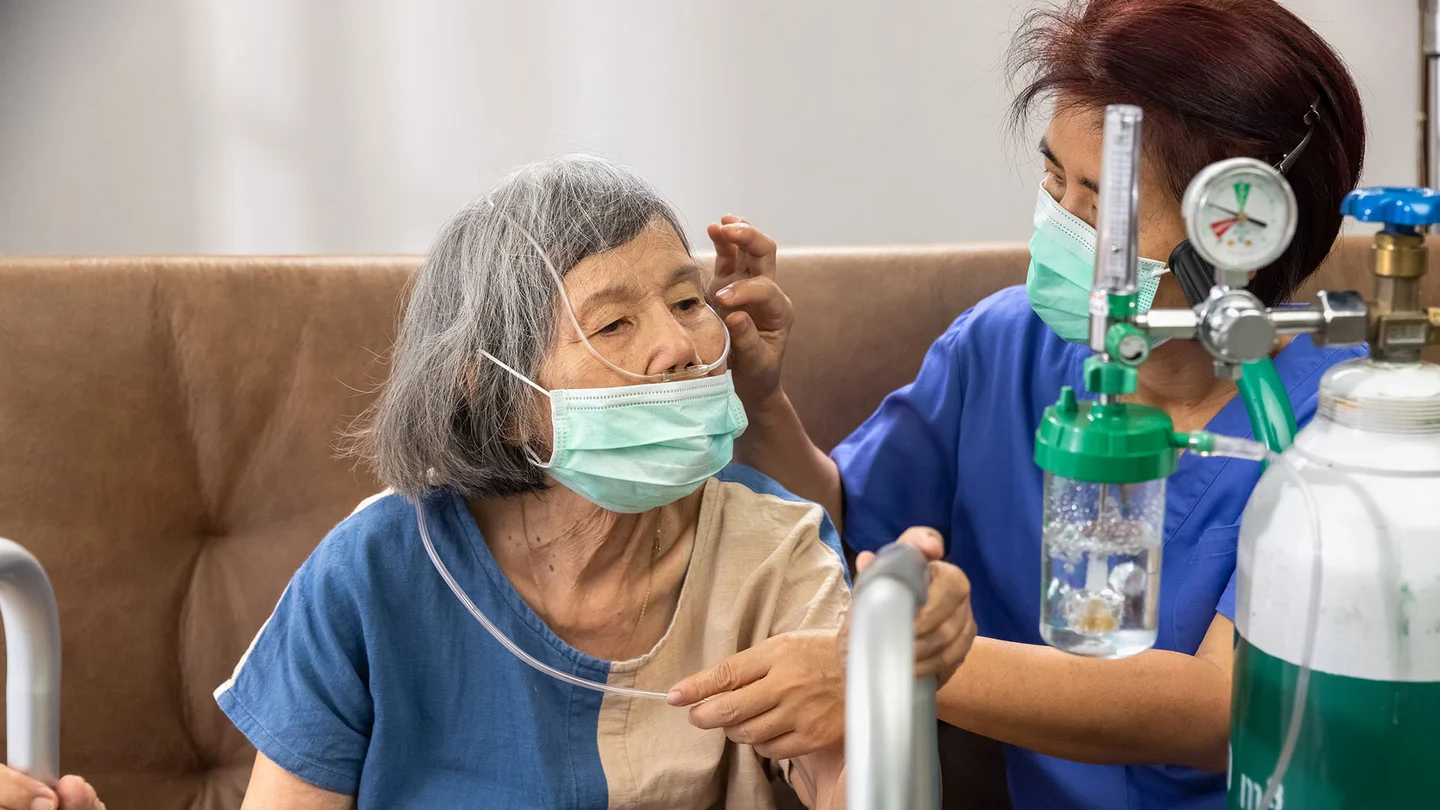
What is out-of-hospital intensive care?
Some people are so critically ill that their health could deteriorate and become life-threatening at any time. This type of life-threatening situation is a particular risk among people on artificial ventilation (also known as artificial respiration).
A critical illness may therefore mean that the person requires special intensive care by a specially trained nursing professional who is present at all times. Out-of-hospital intensive care allows critically ill people to receive the care they need outside of a hospital setting.

Intensive care is intended to enable early detection and intervention if the health of the care recipient changes and becomes life-threatening. For people on artificial ventilation, a further goal may be to wean off ventilator support, i.e., gradually reduce reliance on the ventilator.
Who is entitled to out-of-hospital intensive care?
Certain prerequisites must be met in order for a person to be entitled to receive out-of-hospital intensive care:
- The person has an illness that requires round-the-clock specialist nursing support to enable individual monitoring and operational readiness to deal with any situation that arises.
- It is very likely that life-threatening situations will occur.
- Life-threatening situations could occur at any time, day or night, and without warning.
- Healthcare professionals must be ready to act without delay if a life-threatening situation occurs.
Who prescribes out-of-hospital intensive care?
Out-of-hospital intensive care can be prescribed by doctors who specialize in certain fields of medicine and who have a special qualification. These include doctors:
- of internal medicine and lung disease (pneumology)
- of anesthesia
- of neurology
- with an additional qualification in intensive care medicine
- of pediatric and adolescent medicine
Family doctors and doctors specializing in other fields of medicine may also be entitled to prescribe out-of-hospital intensive care. However, to do so, they must have experience in treating ventilated patients or patients using a nasal cannula and must have been granted approval by the National Association of Statutory Health Insurance Providers (Kassenärztliche Bundesvereinigung).
How is out-of-hospital intensive care prescribed?
For people with statutory health insurance, the prescription of out-of-hospital intensive care is regulated in the Out-of-Hospital Intensive Care Directive (“AKI Directive”) published by the Federal Joint Committee (Gemeinsamer Bundesausschuss, G-BA). Intensive care services have been regulated by this Directive since 1 January 2023. The AKI Directive seeks to improve patient care.
In many cases, out-of-hospital intensive care is initially prescribed when a person is discharged from an inpatient facility. This may be a hospital or rehabilitation facility, for example. In this case, out-of-hospital intensive care can be prescribed for 7 days. However, a registered doctor in a private medical practice can also issue this initial prescription. An initial prescription by a private-practice doctor is valid for a period of 5 weeks. Follow-up prescriptions can be issued for 6 to 12 months.
According to the AKI Directive, the prescription of out-of-hospital intensive care comprises a number of steps. In the first step, the prescribing doctor determines whether the person in need of care requires out-of-hospital intensive care. If so, this step is followed by the potential assessment and the development of a treatment plan.


What facilities provide intensive care?
Intensive care services can be provided in different locations. The location for the intensive care depends, for example, on the needs of the care recipient and on the services available.
Out-of-hospital intensive care may be provided in the following locations:
- at home
- in group homes with ventilator support or other supported living arrangements
- in residential care facilities
- in schools, kindergartens, and workshops for people with disabilities

Important: The wishes of the patient in relation to where the intensive care is to be provided should be considered. These wishes can only be facilitated if it is possible to provide nursing care in the desired location. The Medical Review Board will assess the suitability of the location on an annual basis.
How can I find a suitable facility?
The regional associations of the health insurance funds conclude contracts with providers of out-of-hospital intensive care. One way to find a suitable facility is to consult the prescribing doctor and the relevant health insurance provider. Care support points can also assist in the search for a suitable facility.
To find a care support point close to where you live, refer to the Center for Quality in Care (Zentrum für Qualität in der Pflege) foundation.
Further information can be obtained from the German Interdisciplinary Society for Non-Clinical Ventilation (Deutsche Interdisziplinäre Gesellschaft für außerklinische Beatmung e.V., DIGABR).
Another useful source of information is the Care Guide (“Pflegelotse”) information portal operated by the Association of Substitute Health Insurance Funds (Verband der Ersatzkassen, VDEK).
Who covers the costs of out-of-hospital intensive care?
Statutory health insurance providers cover most of the costs associated with out-of-hospital intensive care. If intensive care is provided in a residential facility, the health insurance provider covers the following costs:
- costs of medical post-treatment care
- care-related costs
- operational investment costs
- costs of accommodation and meals
If the person’s health improves and out-of-hospital intensive care is no longer required, the health insurance provider is still required to cover the costs for a further 6 months. However, this only applies if the person has a need for care with an assigned care grade of 2, 3, 4, or 5.
The care recipient is required to cover the costs of accommodation and meals if receiving care at home or in a care group home.
Are co-payments required for intensive care?
People over the age of 18 are required to pay co-payments. If intensive care is provided in a nursing home, a co-payment of 10 euros per day is required. The total contribution is limited to 28 days per year.
If intensive care is provided in the person’s own home or in a similar location, the co-payment amounts to 10 percent of the daily care costs. In addition, 10 euros must be paid for each prescription. The total contribution is similarly limited to 28 days per year.
Co-payments are only to be made up to the value of 2 percent of the person’s gross annual income or, for those with a chronic illness, 1 percent of their gross annual income.
How can I find a doctor to issue a prescription or conduct a potential assessment?
Only specially qualified doctors are authorized to prescribe out-of-hospital intensive care and conduct potential assessments.
In principle, doctors specializing in lung disease (pneumology), anesthesia, neurology, and pediatric and adolescent medicine with an additional qualification in intensive care medicine are authorized to prescribe out-of-hospital intensive care. You can search for these here:
Search for prescribing doctors
A search function is also provided to help you find doctors who are approved to conduct a potential assessment and issue a prescription:
Search for doctors for potential assessments and prescriptions
In addition to affiliated doctors’ practices, specialist hospitals and other doctors may also be authorized to conduct a potential assessment – see:
Overview of providers (PDF)
Ask in the practice directly whether out-of-hospital intensive care services are prescribed.
Where can I find more information about out-of-hospital intensive care?
Sources of more detailed information about the topic of out-of-hospital intensive care are listed below:
The Federal Joint Committee (Gemeinsamer Bundesausschuss, G-BA) has published the Out-of-Hospital Intensive Care Directive on its website.
The website of the National Association of Statutory Health Insurance Physicians (Kassenärztliche Bundesvereinigung, KBV) provides information aimed primarily at healthcare specialists.
- Allianz Versicherung. Behandlungspflege: Pflege auf ärztliche Anordnung. Aufgerufen am 20.12.2024.
- AOK. Außerklinische Intensivpflege. Aufgerufen am 20.12.2024.
- Gemeinsamer Bundesausschuss. Außerklinische Intensivpflege-Richtlinie. Aufgerufen am 20.12.2024.
- GKV-Spitzenverband. Außerklinische Intensivpflege. Aufgerufen am 20.12.2024.
- Kassenärztliche Bundesvereinigung. Außerklinische Intensivpflege. Aufgerufen am 20.12.2024.
- Medizinischer Dienst. Außerklinische Intensivpflege. Aufgerufen am 20.12.2024.
- Medizinischer Dienst Bund. Außerklinische Intensivpflege. Aufgerufen am 20.12.2024.
- Umsetzungsbegleitung Bundesteilhabegesetz. Außerklinische Intensivpflege-Richtlinie. Aufgerufen am 20.12.2024.