Healthy living What to expect at the birth of a baby
Birth is a very special life event. Many people view child with a great deal of respect. Midwives and medical facilities are there to ensure that birth is as safe as possible.
At a glance
- A vaginal birth (sometimes called a “natural” birth or “normal” delivery) means that the baby is born through the woman’s birth canal.
- If contractions are coming regularly or if your water breaks, it’s important to make your way to your chosen birth location.
- A vaginal birth comprises several stages, which are together known as labor. Firstly, the opening (the os) of the cervix (the neck of the womb) must be fully dilated (open). Next, during the expulsion or pushing stage, the baby is pushed through the birth canal. In the final stage – the placental stage – the placenta (afterbirth) is passed from the body.
- Labor pains can be relieved using behavioral techniques, pain-relieving medication, or spinal anesthesia.
- Vacuum extractors and other birthing aids can also be used to complete difficult births vaginally.
- In some cases, birth via cesarean section (C-section) may be a necessary or desirable.
Note: The information in this article cannot and should not replace a medical consultation and must not be used for self-diagnosis or treatment.

Vaginal birth
In a vaginal birth, the baby is born via the birth canal. This is a natural bodily process that can take place without medical intervention. This is how people were born for millennia.
However, in the past, the rates of infant and maternal mortality associated with childbirth were very high. This is sadly still the case in some developing countries. In Germany, modern medicine has vastly reduced the rate of maternal and infant mortality. In 2023, 2 in 1,000 infants died within 28 days of their birth, while 4 in 100,000 women died during pregnancy or within 42 days of giving birth.
The WHO estimates that a cesarean section is medically necessary in around 10 to 15 percent of all births. However, around 30 percent of all babies born in Germany are delivered by C-section. In some cases, a C-section can be performed on maternal request following careful consideration of the benefits and risks.

Like every person, every birth is unique. In many cases, the birth doesn’t go as expected. This article explains what happens during a vaginal birth and a C-section.
Home birth, birthing center, or hospital birth?
Deciding where to give birth to a baby is a very personal choice. If the pregnancy has been free of complications, the expectant mother is free to choose between giving birth in hospital on an inpatient or outpatient basis, at a birthing center, or at home.
If she wants to be certain that medical care is available to her at all times, then her best option is to have the baby delivered in a hospital. People who want to avoid medication and medical intervention can choose to give birth at a birthing center or at home. With a birthing center delivery or home delivery, the mother will receive individual, one-to-one care from a midwife in a pleasant, homely atmosphere. However, in the event of unforeseen complications, comprehensive medical support will only be available after a delay. Many hospitals and birthing centers host very helpful information evenings and visits.
Criteria for choosing a hospital may include the following:
- layout and equipment in the birthing rooms
- the availability of a midwife-led delivery unit, where a midwife oversees the birth
- the option of having a midwife of your choosing, either as your personal midwife or as a midwife who works with the hospital
- rate of C-sections in the hospital
- the option of “rooming-in”, which means having your baby stay with you in a cot next to your bed
- the availability of family rooms, where your partner and, in some cases, other children are able to stay with you
- “Baby-friendly” certification
You need to make an appointment to register to give birth at a hospital or birthing center. Write down any questions and requests you may have before meeting with the hospital or center for registration. When you register for the birth, your information is recorded and a file created for you. Anything you consider important in relation to the birth can also be recorded in your file.
Inform yourself about issues that are important to you, such as pain management during the birth and what type of care and support will be provided during and after the birth. Seek specific advice from professionals on these matters. This will allow you to make informed choices and ensure that your wishes in relation to the birth are stated in advance.
For more information about choosing where to give birth, see our article Preparing for birth and visit the familienplanung.de website operated by the Federal Institute for Public Health (Bundesinstitut für Öffentliche Gesundheit).
When does it all begin?
The precise signals that trigger labor remain unknown to this day. It is likely that several chemical messengers are produced by the mother, by the baby, and by the placenta, which links the two.
The normal term of a pregnancy is around 40 weeks. Most babies are born within the period beginning 14 days before and ending 14 days after their estimated due date. Only about 4 percent of births happen on the estimated due date.

How will I know when it’s time?
There are various signs that indicate that a woman is going into labor:
- The water breaks and amniotic fluid gushes or trickles out.
- Labor pains (contractions) occur at intervals of 5 to 10 minutes.
If you notice at least one of these signs, you should contact your midwife or go to the hospital. The midwife will perform a vaginal examination to determine whether the cervix has begun to dilate and the birth is underway.
Important: If the mucus plug that seals the cervix during pregnancy is discharged out of the vagina, this can be the first sign that labor will begin very soon. However, this can also happen several days beforehand. As a rule, there’s no need to go to the hospital immediately if this happens.
How will I know that “true” labor has really started?
Not every painful contraction of the womb indicates the start of labor. There are several types of contractions, some of which may occur long before the birth:
- Braxton Hicks: When the womb contracts noticeably but without causing pain, these are known as Braxton Hicks contractions. They do not affect the cervix.
- Early or lightening contractions: These can occur in the final 4 weeks of pregnancy and serve to move the baby’s head down into the pelvis. They can sometimes be painful and can shorten (efface) the cervix, but they generally do not yet cause it to dilate.
- Dilating pains (first-stage labor pains): These are initially irregular but later become regular, painful contractions occurring at intervals of 3 to 5 minutes or less. These help dilate the cervix and mark the start of labor.
- Second-stage labor pains: These are strong, painful contractions occurring 2 to 5 minutes apart and help the baby to make its way through the birth canal. They occur once the cervix is fully dilated.
- Pushing contractions: These occur when the woman feels a strong urge to push with the abdominal muscles. They usually occur shortly before the baby is born.
- Third-stage labor pains: Once the baby is born, the womb contracts and expels the afterbirth (placenta). These contractions reduce bleeding from the internal wound in the location where the placenta was attached to the womb.
- Afterbirth contractions/post-partum contractions: These help the womb recover and return to its normal size. They also promote the return of the woman’s menstrual cycle. These contractions often occur during breastfeeding because the hormone oxytocin, which triggers milk production, also causes contractions of the womb.
What are the stages of a vaginal birth?
A vaginal birth normally lasts around 4 to 18 hours. For first-time mothers, labor usually lasts somewhat longer. There are four stages of labor:
First-stage labor
During the first stage of labor, the cervix slowly opens until it is fully dilated. This allows the baby to move from the womb through the cervix and vagina. Hormones ensure that the tissue in the area becomes soft and stretchy.
Second-stage labor
The second stage of labor begins when the cervix is fully dilated to approximately 10 centimeters. The bony pelvis has an oval opening at the top and another at the bottom. The upper opening is oriented from side to side, while the lower opening is oriented from front to back. As it moves through the birth canal, the baby makes a slight 90-degree turn due to the funnel shape of the pelvis. The contractions during this stage help the baby on its way.
Pushing phase
Shortly before the baby’s head emerges through the vaginal opening, the mother will experience pushing contractions. She will feel a strong urge to push with her abdominal muscles during each contraction. Most babies are born head first and facing toward the mother’s back. If the baby is born face upward, this is known as the stargazer position. Once the head is delivered, the shoulders will follow with the next few contractions. The rest of the body is quickly delivered soon after. Babies in a breech position can also be born vaginally. In this case, the baby’s bottom enters the birth canal first.
Third-stage labor
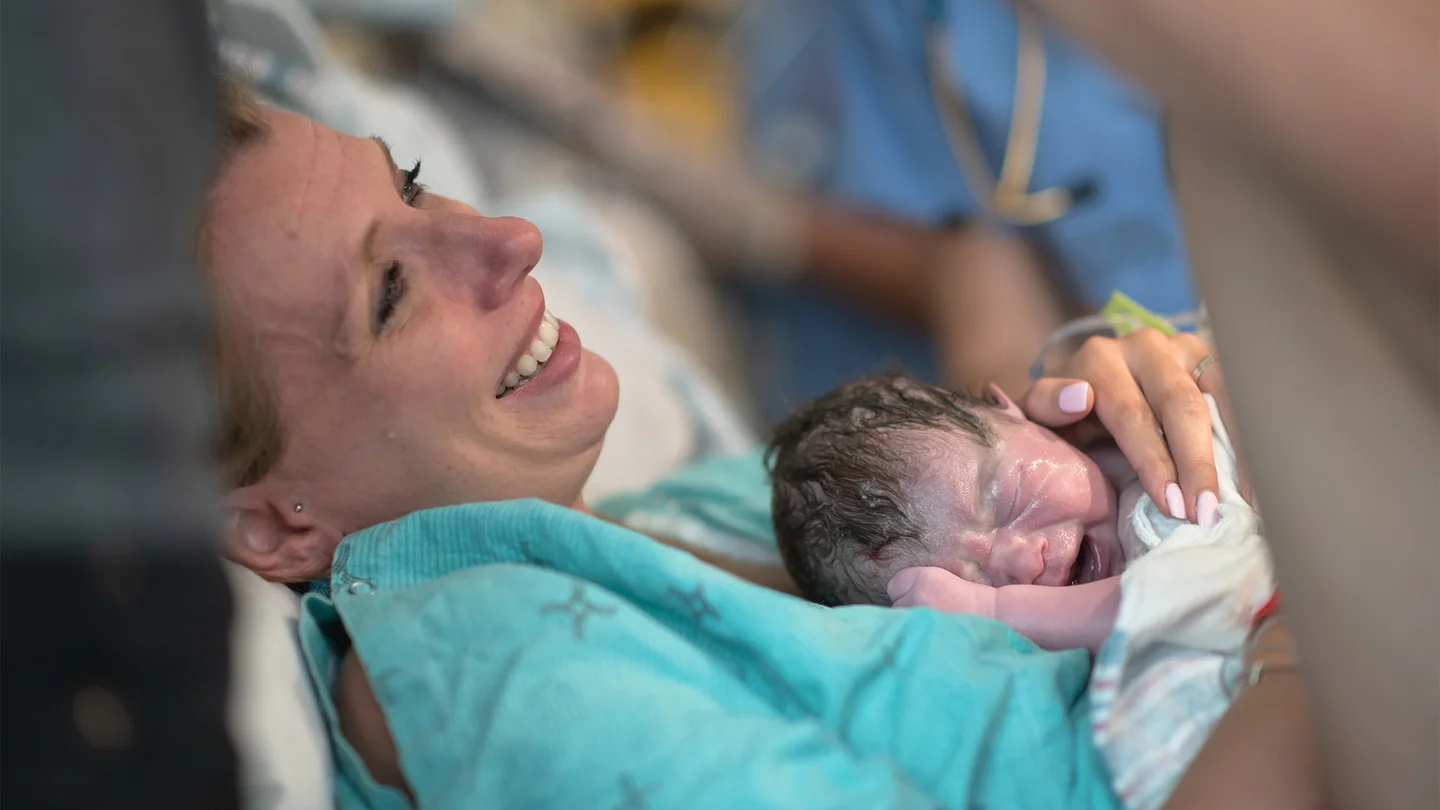
Once born, the baby takes its first breath. The lungs expand and the baby often cries. The midwife then places the baby on the mother’s chest. The midwife cuts the umbilical cord and cleans and examines the baby. Contractions during the third stage of labor help deliver the placenta (afterbirth), which is checked to ensure that it is complete. If the baby suckles at the mother’s breast, this stimulates her body to expel the placenta.
What birthing aids are available?
Labor may be delayed or become stalled during each stage. If this happens, various aids can be used to help labor progress and the birth to be completed vaginally:
Oxytocin infusion
If labor is slow to progress, synthetic oxytocin can be given intravenously to make the contractions of the uterus stronger.
Vacuum extractor (ventouse)
If labor becomes stalled during the second stage, the baby is already in the birth canal. In this case, the doctor may use a vacuum extractor (also called a ventouse) to deliver the baby. During a vacuum-assisted delivery, the midwife continues to support and guide the mother. A cap made of metal or plastic is placed on the baby’s head and attached by suction. This doesn’t injure the baby. Marks may be visible on the skin after birth where the cap was attached but these usually don’t take long to disappear.
Ways to manage labor pain
Women can have widely differing experiences of pain during labor. As a rule, fear and tension make the pain more difficult to bear. That’s why many approaches used in preparation for and during labor are aimed at creating a relaxing atmosphere.
There are various ways to successfully manage pain during labor. It’s best for the expectant mother to discuss these with her midwife before the birth. No one should have to endure unbearable pain. The following methods of pain relief can be used during labor:
Non-medical pain relief
During the first stage of labor in particular, changing positions or taking relaxing baths can help make the pain more bearable. Other options include taking short walks, sitting on a gym ball, and using relaxation and breathing exercises. Alternative methods such as acupuncture may also help.
Anti-spasmotics
Anti-spasmotic medication can be administered during the first stage of labor and help the cervix to dilate.
Painkillers
Mild painkillers can provide relief during the first stage of labor. Stronger medication, such as opiates, can be used as labor progresses but can no longer be used as the end of labor approaches. If opiates are administered shortly before the baby is delivered, they can affect the baby’s breathing after the birth. Nitrous oxide (“laughing gas”) can also be used as pain relief during labor.
Epidural anesthesia
Effective relief for painful contractions can be provided by means of a catheter inserted into the lower back close to the spinal cord, which delivers pain relief as required or continuously. A thin, flexible tube is inserted into the epidural space in the lower back to deliver pain medication. This blocks the transmission of pain signals from the pelvis.
The decision as to whether to administer an epidural should be made before the contractions become too strong but after the cervix has begun to dilate. An epidural delivers reliable pain relief, and can also be used if a C-section is required. However, the drawback of an epidural is that it often makes labor slower and contractions weaker. For this reason, an intravenous infusion of oxytocin is often given to help strengthen contractions. The urge to push is often somewhat weaker with an epidural. Other possible side-effects are a drop in blood pressure and difficulty passing urine.
Spinal anesthesia (spinal block)
With spinal anesthesia, pain-relieving medication is injected directly into the fluid around the spinal cord. This provides very rapid pain relief. Spinal blocks are used in particular if a C-section is required. The advantages of this method over general anesthesia are that the mother can remain conscious to experience the birth of her baby and that the baby can be placed in her arms immediately after the birth.
Pudendal nerve block
If pain relief is needed later in labor, pain signals from the external genitals and the perineum (between the vagina and anus) can be blocked with an injection through the vaginal wall. However, use of this method has become extremely rare.
What are the potential effects of a vaginal birth on the mother’s body?
Although the tissue in the area is made soft and stretchy, the baby’s delivery through the birth canal can still cause injuries to the membranes lining the vagina, for example. Small tears will heal on their own. Larger tears can be stitched back together shortly after the birth.
Injuries to the perineum
The perineum is the area of soft tissue and muscle between the vagina and anus. Midwives protect the perineum during the pushing stage of labor using specific hands-on techniques (manual perineal protection). However, if strong pushing contractions accelerate the delivery, tears may still occur in the perineal area.
In particular when delivery instruments such as a vacuum extractor are used, it may be necessary to perform an episiotomy, i.e. make an incision in the perineum to widen the opening of the birth canal. Injuries to the perineum are treated shortly after the delivery.
Partial retention of placental tissue in the womb
It is important to check that the placenta is complete after it has been delivered. If parts of the placenta remain in the womb, this can have very serious consequences, such as heavy bleeding. If the placenta is incomplete, the doctor will remove any remaining parts from the womb manually. This procedure is done under anesthesia.
Postpartum hemorrhage (severe bleeding after the birth)
Hemorrhaging may occur after a vaginal birth or a C-section. The main cause of severe and potentially life-threatening hemorrhage after the birth is uterine atony. This means that the uterus fails to contract sufficiently after the birth.
To manage this risk, a woman who has given birth is kept under observation for 2 to 4 hours. After the birth, the body’s own hormone oxytocin causes the uterus to contract. The release of oxytocin is stimulated by the baby suckling at the mother’s breast.
What are the reasons for delivering a baby by cesarean section?
Toward the end of pregnancy, most babies are positioned lengthwise, with their spine running in the same direction as (parallel with) the mother’s spine. A vaginal birth isn’t possible if the baby is in a transverse lie or an oblique lie. The position of the placenta and the health of the mother or the unborn baby are other reasons why a C-section may be necessary. Today, the cesarean section is a routine procedure that saves lives and can prevent birth complications.
Many C-sections can be planned in advance (planned C-section). If a C-section is not planned but becomes necessary during labor, this is referred to as an unplanned C-section. In some cases, an emergency C-section may need to be performed as a matter of urgency to allow the baby to be delivered as soon as possible. This is always the case if the life of the mother or child is at acute risk.
Reasons that make a C-section necessary
- The baby’s lie or presentation in the womb means that a vaginal delivery isn’t possible.
- The position of the placenta in the womb means that the baby cannot enter the birth canal.
- The mother has previously had a C-section that required a vertical incision, which means that there is now a risk of the womb rupturing during labor.
- The baby is too big for the mother’s pelvis.
- Labor has stalled and there is no other way to help it progress.
- The mother is experiencing high blood pressure and convulsions (eclampsia; HELLP syndrome).
Reasons that may make a C-section necessary
- The mother has had a C-section previously.
- The baby’s lie or presentation in the womb could make labor more difficult.
- The mother is carrying multiples (twins, triplets, etc.).
- Labor has stalled.
- There are indications of abnormal growth, diseases, or abnormalities in the unborn baby.
- The mother has a health condition that makes a C-section necessary, such as certain heart diseases or severe metabolic disorders.
- The stress of labor is putting the health of the mother at risk.
- Labor has been especially long and the mother is exhausted.
Urgent reasons for an emergency C-section
- The placenta has prematurely separated from the wall of the womb, which, in most cases, leads to severe bleeding.
- The umbilical cord has slipped through the open cervix into the birth canal ahead of the baby and is caught between the baby and the birth canal (umbilical cord prolapse).
- A uterine rupture (rupture of the womb) has occurred.
- The baby’s heart rate slows and the baby’s oxygen supply is at risk.
C-section on maternal request
A C-section on maternal request is one that is performed without a medical indication and exclusively at the request of the expectant mother. C-sections on maternal request are relatively rare in Germany (representing just 2 to 3 percent of deliveries) and have to be paid for privately. The benefits and risks of undergoing the operation must be weighed up in advance in consultation with a doctor.
What are the various stages of a C-section delivery?
First, the doctor ensures that the mother cannot feel any pain. This is usually done by means of spinal anesthesia, which allows the mother to remain conscious during the delivery. It also means that the baby can be placed in the mother’s arms immediately after the birth. General anesthesia has a faster effect and may be used for emergency C-sections in particular.
The surgeons first makes a horizontal incision in the abdomen about two finger-widths above the pubic bone. They then cut through the abdominal wall muscles and the peritoneum (lining of the abdominal cavity). Next, a horizontal incision is made in the womb. The doctor lifts the baby out by hand and cuts the umbilical cord. The placenta is also removed manually. Finally, all layers are stitched back together. It usually only takes a few minutes between the first abdominal incision and the delivery of the baby.
After a C-section, mother and baby usually stay in hospital for 3 to 4 days. Although this is a routine procedure, complications such as infections or hemorrhage may still occur. However, severe complications are rare (less than 1 percent).
What are the advantages and disadvantages of a C-section delivery compared with a vaginal delivery?
Vaginal birth is the natural physiological process by which a baby is born. The advantage of vaginal birth is that the narrow birth canal helps push amniotic fluid out of the baby’s lungs, allowing them to expand more easily with the baby’s first breath. This means fewer breathing difficulties after delivery. It is also thought that the baby’s contact with the healthy bacteria in the mother’s vagina has a positive health benefit, although this hasn’t been scientifically proven.
Drawbacks of a C-section
For the mother:
- increased risk of thrombosis and pulmonary embolism
- increased risk of painful adhesions or tears in the uterine scar during subsequent pregnancies
- milk production is delayed by about one day
- the wound may be painful
- if the C-section was unplanned, the mother may take some time to mentally process what has happened
For the baby:
- more frequent breathing difficulties in newborns
- slightly elevated risk of allergies, asthma, and diabetes later in life
Benefits of a C-section
- no birth injuries in the perineal area
- fewer pelvic floor issues
- Die Geburt. Portal „familienplanung.de“. Aufgerufen am 12.08.2025.
- Lasch L. Fillenberg S. Basiswissen Gynäkologie und Geburtshilfe. Springer: Berlin 2017.
- Schwangerschaft und Geburt. Portal „Frauenärzte im Netz“. Aufgerufen am 12.08.2025.
- Schwangerschaft und Geburt. Portal „gesundheitsinformation.de.“ Aufgerufen am 21.01.2021.
- Maternal Mortality Ratio. The World Bank Data. Aufgerufen am 20.08.2025.

Reviewed by the German Midwifery Association (Deutscher Hebammenverband e.V.).
As at: